en
en  de
de 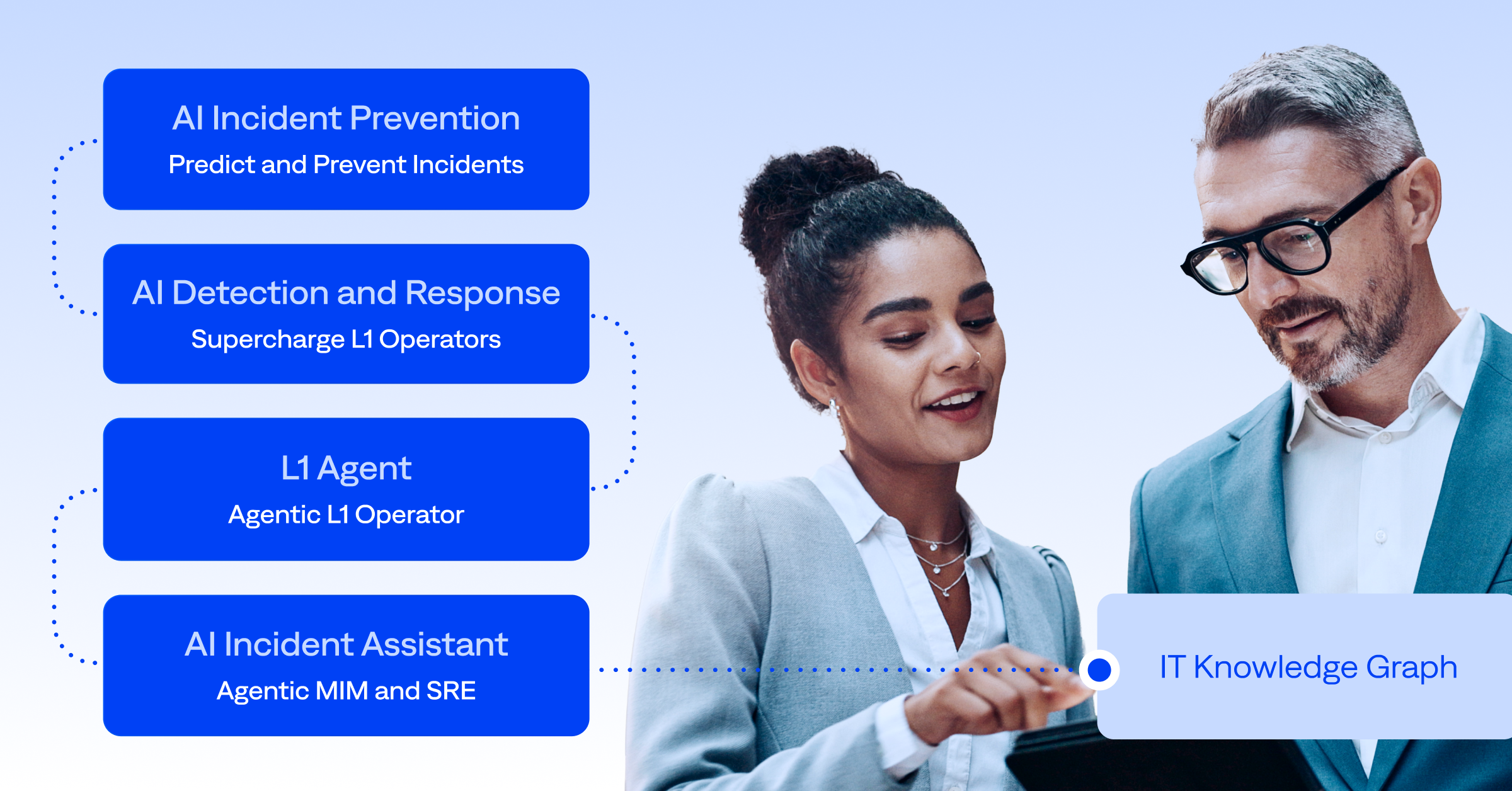








1
What is IT incident management?
Imagine you’re in the middle of a critical project, and suddenly, your system crashes. Or it’s the middle of the night, and your server goes down, affecting countless users. While no enterprise can avoid all IT incidents, how you handle them can significantly reduce their impact.
Fast, effective IT incident management is critical, as major incidents are increasingly costly. On average, organizations lose $14,056 per minute of unplanned downtime, and that number jumps to $23,750 per minute for large enterprises, or $1.5 million per hour. Service interruptions also damage customer experience and trust, as well as and business productivity.
IT incident management is the process of identifying, analyzing, and fixing incidents to restore normal service operations. The goal is to minimize business impact, increase productivity, and prevent business-threatening situations.
Today, modern enterprises are moving beyond reactive, manual incident management to proactive, automated operations. Agentic IT operations bring autonomous, intelligent agents into the incident management lifecycle to detect, triage, and resolve incidents faster and with less human toil. Where traditional IT teams struggled to keep pace with alert floods and hybrid-cloud complexity, agentic ITOps empowers teams to shift from reactive firefighting to proactive resilience.
2
What is incident management in IT?
Incident management operates as a component of the IT service management (ITSM) framework, which focuses on addressing and resolving IT-related incidents.
An IT incident is any unplanned interruption or degradation of IT services. ITOps teams handle various incidents, including software or hardware failures, email issues, security breaches, user errors, and, in the worst case, outages. Incidents are not to be confused with IT events or problems, which are defined as follows.
- Incidents are any non-scheduled IT service disruption or degradation.
- Events are any observable occurrences in an IT system, whether normal operations or errors.
- Problems are the underlying root cause of one or multiple incidents, often hinting at a deeper issue in the IT infrastructure.
According to ITIL guidelines, problem management focuses on preventing or reducing incidents, while incident management addresses real-time issue resolution.
The BigPanda Agentic ITOps platform bridges this distinction by continuously correlating events, identifying recurring problems, and automating the handoff between reactive incident response and proactive problem prevention — all through its IT Knowledge Graph and AI-powered detection capabilities.
3
What is the goal of incident management?
If you’re not well-equipped to handle IT incidents, you risk costly outages and unhappy customers. Many organizations still rely on manual incident-management processes. As a result, they struggle to keep pace with rapidly evolving agile methodologies or hybrid-cloud environments.
Contemporary organizations maintain an incident management team to address unforeseen disruptions and malfunctions. Dependable teams and transparent processes are crucial for managing unplanned incidents and effectively upholding service-level agreements (SLAs).
A well-defined strategy plays a pivotal role in prompt and efficient incident resolution. It also helps avert future incidents, refine business operations, and enhance customer satisfaction.
The goal of agentic ITOps is to push that strategy further, not just to resolve incidents faster, but to prevent them entirely. BigPanda AI Incident Prevention offers capabilities including predictive analytics and change risk intelligence to identify high-risk conditions before they become outages, shifting teams from reactive firefighting to proactive control.
4
Why is optimizing incident management important?
Efficient issue resolution is essential to minimize downtime, preserve reputation, and reduce costs. Incident management is vital to upholding SLAs, meeting compliance requirements, and efficiently managing risk. Through continuous improvement, your approach can enhance IT system resilience and improve overall business stability.
As IT environments grow more complex — spanning multi-cloud, hybrid infrastructure, and rapidly deployed microservices — the stakes for poor incident management have only increased. Agentic ITOps transforms incident management from a cost center into a competitive advantage, enabling organizations to maintain the reliability customers expect while freeing engineering teams from repetitive, manual work.
5
Incident management in ITIL
Incident management is a significant component of ITIL service support. ITIL incident management provides the framework for minimizing the negative impacts by restoring services as soon as possible.
Successful ITIL incident management necessitates clear roles among stakeholders. The incident manager oversees the process and ensures timely resolution in accordance with the SLAs.
Support levels may cover a range of responses and teams, including:
- The service desk or NOC is for initial contact and basic troubleshooting.
- Technical teams can respond quickly using incident-management tools.
- Hardware/software engineering teams to address specific system issues.
With Agentic ITOps, BigPanda augments each of these support tiers. The BigPanda L1 Agent autonomously handles L1 tasks, including monitoring alerts, correlating incidents, and routing tickets to reduce the volume of issues that escalate to human engineers. The BigPanda AI Incident Assistant empowers L2, L3, and SRE teams with contextual analysis, recommended actions, and synthesized incident summaries, enabling them to resolve complex issues faster.
6
What are the five steps of IT incident management?
The ITIL incident management process includes procedures and actions for responding to and resolving incidents. The process involves five steps that outline the entire incident lifecycle, identify concerned stakeholders, describe how to detect and communicate incidents, and specify the tools used for resolution.
Step 1: Incident identification
Detection starts with user alerts, infrastructure metrics, or unusual behavior. Regardless of incident origin, the service desk team logs alerts, noting key details and assigning a unique ID for tracking.
Incident intelligence tools detect and highlight anomalies, ensuring quick responses and fewer escalations. Effective tools can significantly reduce resolution time and streamline incident logs.
Agentic ITOps in action: AI Detection and Response
BigPanda AI Detection and Response continuously monitors signals across your entire tool ecosystem, automatically correlates related alerts into unified incidents, and reduces the noise that buries critical signals. Rather than waiting for a user to report a problem, the platform surfaces incidents the moment anomalous patterns emerge, dramatically shrinking detection time.
Step 2: Incident categorization
Incident response begins after triaging according to your organization’s protocols. Proper triage prevents misclassification. Incidents are grouped for easier tracking and addressing user impacts. After categorization, it’s essential to reference past incidents for insights.
Categorization streamlines information gathering and diagnosis, enhancing the efficiency of incident management. Until the incident is resolved, these categories guide escalation activity. Successful escalation hinges on accurate categorization and clear responsibilities.
Agentic ITOps in action: The IT Knowledge Graph
The IT Knowledge Graph continuously maps relationships between services, infrastructure components, and historical incidents to provide the rich context that makes AI-powered categorization accurate and actionable. When a new incident surfaces, the platform instantly enriches it with topology context, change history, and similar past incidents, giving responders the full picture from the moment it occurs.
Step 3: Incident prioritization
Use priority matrices to assess incidents according to importance. The prioritization helps service desk analysts gauge response urgency and set customer expectations. The system assigns a prioritization code based on business impact and response urgency when it logs an incident.
Factors that affect prioritization may include:
- Number of affected customers or users.
- Number of services or IT systems affected.
- Significance of the disrupted service(s).
- Potential revenue loss or resolution cost.
Urgency relates to resolution time, SLA targets, and the service’s criticality. BigPanda automates prioritization by applying business context from the IT Knowledge Graph to ensure that high-impact incidents are surfaced to the right teams immediately.
Step 4: Incident response
Incident response uses a structured approach to guide teams through resolution. Following prioritization, the focus moves to containment to prevent further damage.
If unresolved, the issue is escalated for deeper analysis. Key steps include gathering and analyzing data and performing a root-cause analysis (RCA) to pinpoint the incident’s origin, aiming to reduce the mean time to resolution (MTTR).
Be sure to document your incident solution and the probable root cause in your knowledge base or configuration management database (CMDB). Incident response plans must remain dynamic, receiving regular updates and integrating real-time user feedback to ensure ongoing effectiveness.
Agentic ITOps in action: The BigPanda AI Incident Assistant
For L2, L3, and SRE teams handling complex incidents, the AI Incident Assistant acts as an always-on expert teammate. It synthesizes correlated alerts, relevant topology data, and historical resolution patterns into clear incident response actions. Engineers spend less time gathering context and more time resolving issues. At the same time, customizable AI workflows let teams define step-by-step response playbooks that the platform executes automatically, ensuring consistent, accurate responses every time.
Step 5: Incident closure
Establish closure through postmortem documentation and assessing response actions. This evaluation identifies opportunities for improvement, helping develop proactive measures for future incidents and bolstering organizational resilience.
Rechecking the incident’s initial categorization is vital; misclassifications can increase MTTR. Once the closure checklist is complete, share a detailed report to enhance trust with stakeholders.
Incident management has traditionally required a time and resource-intensive process with many stakeholders. Agentic ITOps simplifies it by accelerating resolution and continuously learning from each closure event to improve future detections, categorizations, and response recommendations.
7
How to optimize IT incident management with agentic ITOps
To remain productive and efficient, it’s important to focus on optimizing and using incident management best practices. Automate as much as possible to rapidly identify, assess, and resolve issues. Agentic ITOps extends this by putting AI agents to work autonomously across the incident lifecycle so your human experts can focus on what matters most.
Shift L1 from reactive to autonomous with the BigPanda L1 Agent
Most IT organizations spend enormous resources on repetitive, low-complexity L1 tasks like monitoring dashboards, acknowledging known alerts, routing tickets, and documenting incidents. The BigPanda L1 Agent automates these tasks, acting as a tireless digital operator that monitors your environment 24/7. It correlates alerts, triages incidents, initiates workflows, and escalates issues to human engineers only when genuinely needed.
Prioritize early detection with AI-powered insights
Most IT teams use more than 20 observability and monitoring tools, resulting in an overwhelming volume of alerts. BigPanda AI Detection and Response distills event data so teams can act quickly, saving valuable time with early detection and efficient presentation of incidents to IT staff and dramatically reducing the time between signal and response.
Streamline response with customizable AI Workflows
The BigPanda agentic ITOps platform enables teams to define and automate workflows for major incident management tailored to their specific operations. Rather than one-size-fits-all automation, BigPanda offers customizable AI workflows that execute consistently across every incident. This ensures the right experts are engaged at the right time with the right context, eliminating the coordination overhead that extends MTTR during high-pressure situations.
Improve incident visibility with Unified Analytics and dashboards
Agentic ITOps helps systematically handle and review major incidents. Advanced analytics and dashboards provide deeper insights, highlighting recurring patterns and potential workarounds. BigPanda Unified Analytics provides teams with a clear view of operations, allowing them to track KPIs, monitor SLA compliance, and surface opportunities for continuous optimization, turning each incident into an input for smarter, more resilient operations.
Automate root-cause analysis and prevent future incidents
Root-cause analysis is traditionally used after an outage to identify how to prevent future incidents. BigPanda AI Incident Prevention applies predictive intelligence to proactively identify conditions likely to cause outages — such as high-risk IT changes — before they occur. AI-powered change risk management integrates with your ITSM workflows to automatically flag risky changes, so your teams can intervene before incidents occur rather than scrambling to recover afterward.
8
Transform incident management with agentic ITOps from BigPanda
The era of reactive, chaotic incident management is over. Today’s enterprises need an approach that is autonomous, intelligent, and continuously learning to keep pace with the scale and complexity of modern IT environments.
The BigPanda agentic IT operations platform offers enterprises a new paradigm for IT incident management. Our platform delivers accurate, up-to-date, real-time visibility into your applications, services, and infrastructure while reducing noise, correlating multi-source alerts, and enabling powerful workflow automations. With BigPanda, enterprises can:
- Detect incidents faster with AI-driven signal correlation across every monitoring tool.
- Triage and categorize incidents automatically, with full topology and historical context.
- Automate L1 operations end-to-end, freeing human experts for complex problem-solving.
- Respond consistently with customizable AI Workflows that execute best-practice playbooks.
- Prevent incidents before they happen with predictive change risk intelligence.
- Continuously improve with Unified Analytics that turns every incident into operational insights.
It’s time to move from reactive chaos to proactive resilience. To learn more about the value agentic ITOps brings to IT incident management, you can check out our latest ebook linked below or schedule a demo to see BigPanda in action today.